With relative humidity averaging 70 to 80 percent year round, South Florida custom homes need materials that stay dimensionally stable and resist mildew: white oak, walnut or teak rather than pine or cherry, engineered hardwood flooring over solid planks, and plywood cabinet boxes instead of MDF or particle board. Mildew resistant paint, epoxy or urethane grout, and right sized HVAC with supplemental dehumidification where needed protect the interior. Outside, block with stucco, natural stone, fiber cement and aluminum or stainless hardware hold up, while unsealed wood siding and mild steel fasteners fail.
South Florida's humidity is a constant environmental pressure on every material in a custom home. Average relative humidity runs 70 to 80 percent year-round, with summer afternoon peaks above 90 percent. That reality attacks material specifications that work fine in drier climates. Wood species that thrive in the Pacific Northwest swell, warp, and mold here. Cabinet construction that is standard in Texas fails in Ocean Ridge. Paint coatings that protect homes in Arizona delaminate in Boca Raton. Material choices in South Florida custom homes need to be made with humidity in mind from specification through installation.
Wood species for interior applications
Not all woods handle South Florida humidity well. The species that perform include:
- White oak (particularly rift-cut or quartered): dimensionally stable, resists cupping, widely available
- Walnut: stable, excellent appearance, moderate cost
- Teak: exceptional moisture resistance, premium cost, limited availability
- Sapele and mahogany: good moisture resistance, tropical hardwoods
- Reclaimed antique wood: often very stable because it has fully equilibrated to moisture over time
Species to avoid or use carefully:
- Pine (most species): soft, susceptible to swelling and insect damage
- Cherry: dimensionally unstable, color shifts aggressively in humid heat
- Maple (some species): can develop mold staining in high-humidity applications
- Unsealed softwoods in any location
For hardwood flooring, engineered construction (plywood core with hardwood veneer) outperforms solid wood in our climate. Engineered flooring at 5/8 or 3/4 inch thickness handles humidity changes better than solid 3/4 inch planks, which can cup, crown, or gap significantly as humidity fluctuates.
Cabinetry construction
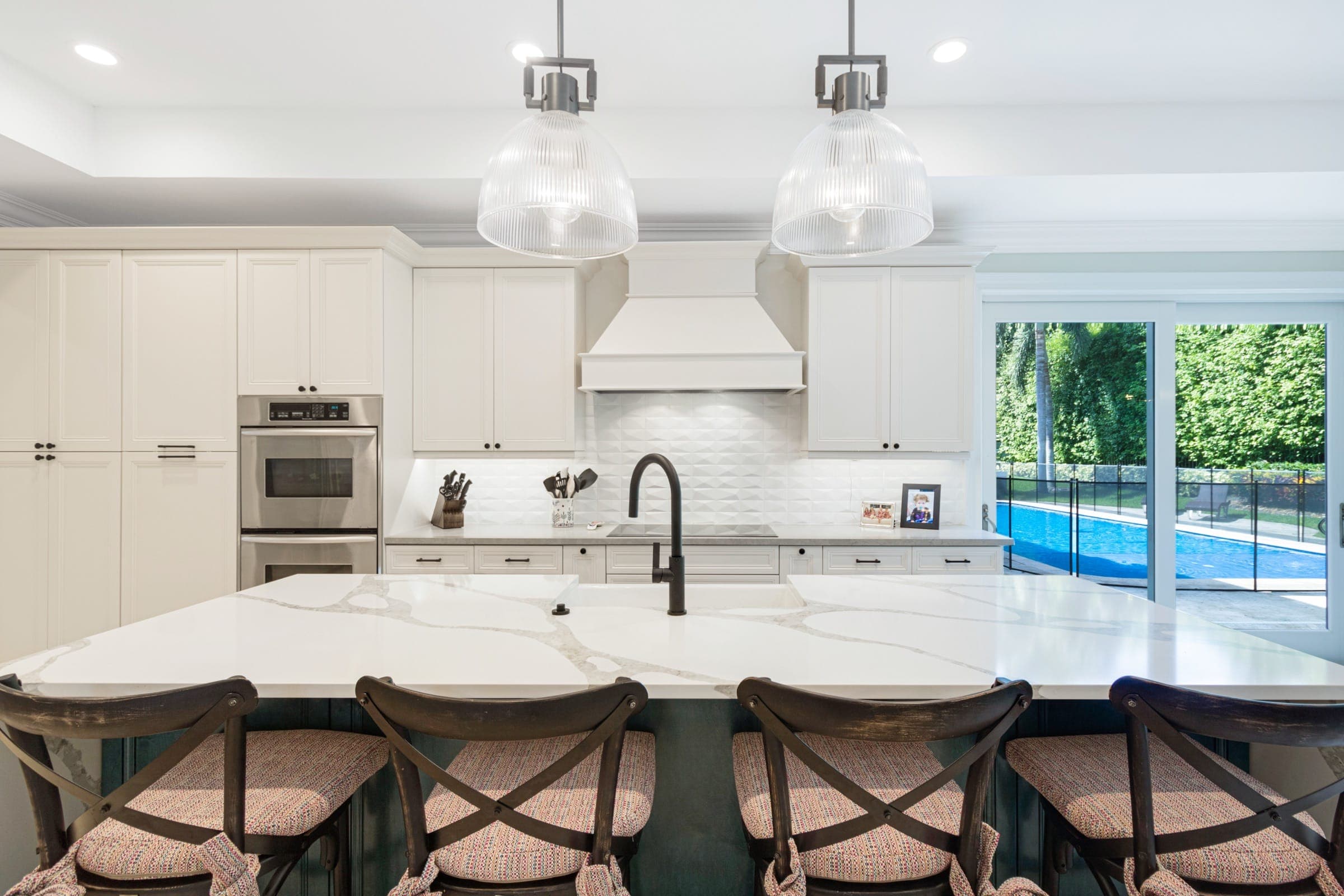
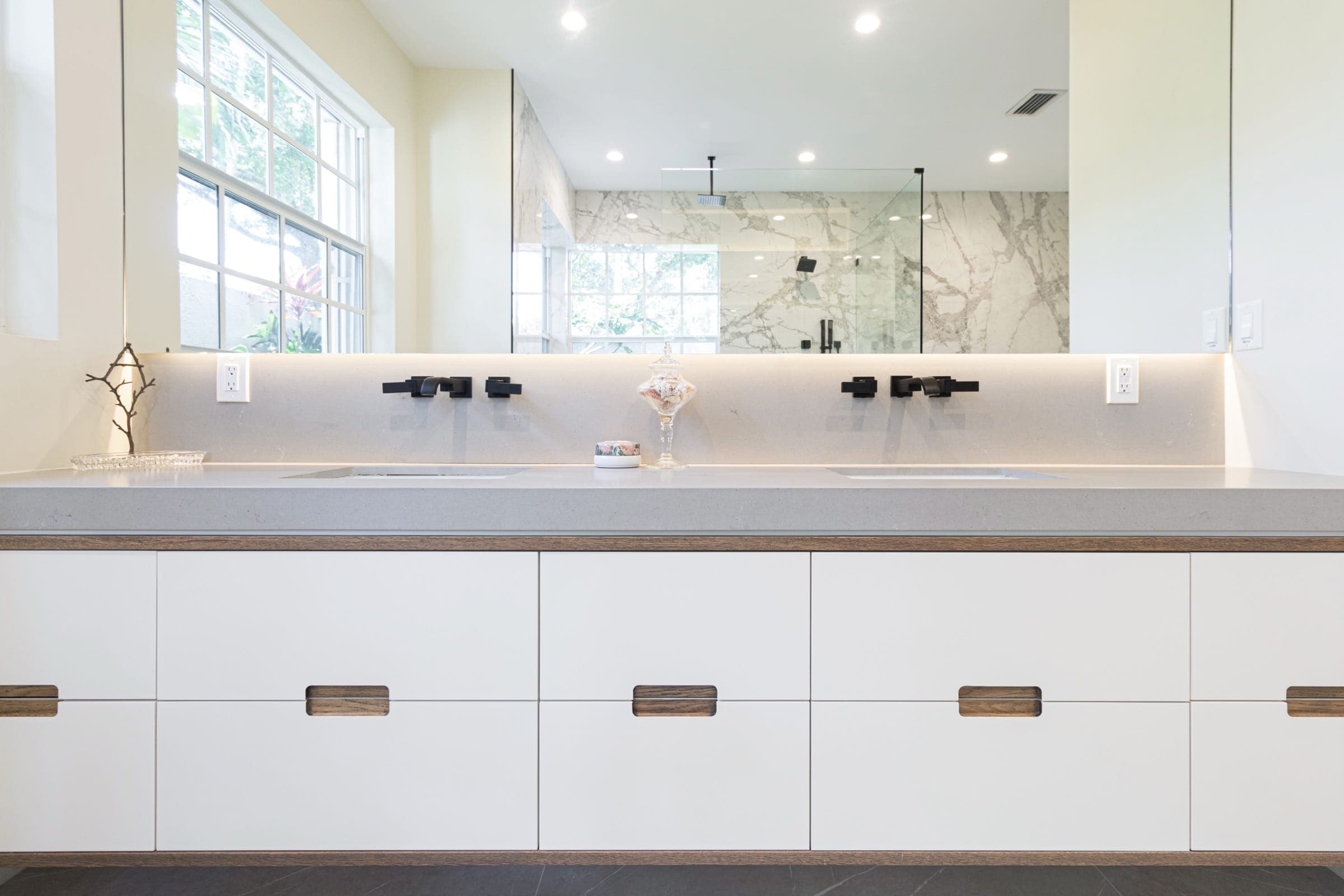
Cabinet boxes built from plywood outperform MDF or particle board in humid climates. Plywood's cross-laminated construction resists moisture-driven dimensional changes better than single-direction materials. Premium cabinet manufacturers specify plywood carcasses on all their higher-end lines. MDF may still appear on door panels (where dimensional stability is less critical and MDF accepts paint beautifully) but should not be used in the cabinet carcass.
Cabinet finish also matters. Conversion varnish and catalyzed polyurethane finishes outperform standard lacquer in humidity. On high-end cabinetry, the finish specification is typically a multi-step catalyzed system applied in a controlled environment, not field-applied after installation.
Paint and coating systems
Interior paint selection in South Florida favors mildew-resistant formulations, particularly in bathrooms, laundry, and kitchen applications. Sherwin-Williams Duration, Benjamin Moore Aura Bath and Spa, and Behr Marquee are among the products commonly specified for moisture-exposed areas.
Exterior paint systems need to handle UV, humidity, and occasional salt exposure. Quality elastomeric or acrylic products outlast cheaper alternatives significantly in South Florida conditions. On new construction, quality exterior paint runs 7 to 10 years between recoats. Lower-quality product can fail in 3 to 5 years, creating maintenance costs that dwarf the paint savings.
Tile and stone
Tile and natural stone perform exceptionally well in South Florida humidity. Porcelain tile, glazed ceramic, quartzite, granite, and marble all handle moisture without issue. Installation details matter more than material choice: proper grout sealing, adequate waterproofing in wet areas, and expansion joint placement all affect long-term performance.
Grout selection deserves attention. Epoxy grout and urethane grout resist staining and microbial growth better than standard cementitious grouts, which can yellow and harbor mildew in shower applications. The cost premium for epoxy or urethane grout is small relative to total installation cost.
HVAC and dehumidification
Home mechanical systems play a significant role in managing interior humidity. Properly sized air conditioning removes moisture as a byproduct of cooling, but oversized systems run short cycles that cool the air without adequately dehumidifying it, leaving interior humidity above comfortable levels. Right-sized systems (often smaller than rule-of-thumb estimates suggest) dehumidify more effectively.
Supplemental dehumidification is common in well-insulated high-efficiency homes where the cooling load alone does not produce enough dehumidification. Whole-house dehumidifiers sized at 70 to 135 pints per day are typical supplements on custom homes of our scale. These systems run independently of the HVAC system and maintain target interior humidity regardless of cooling demand.
Exterior material longevity
Exterior materials face combined humidity, UV, and salt exposure (on coastal sites). The specifications that hold up:
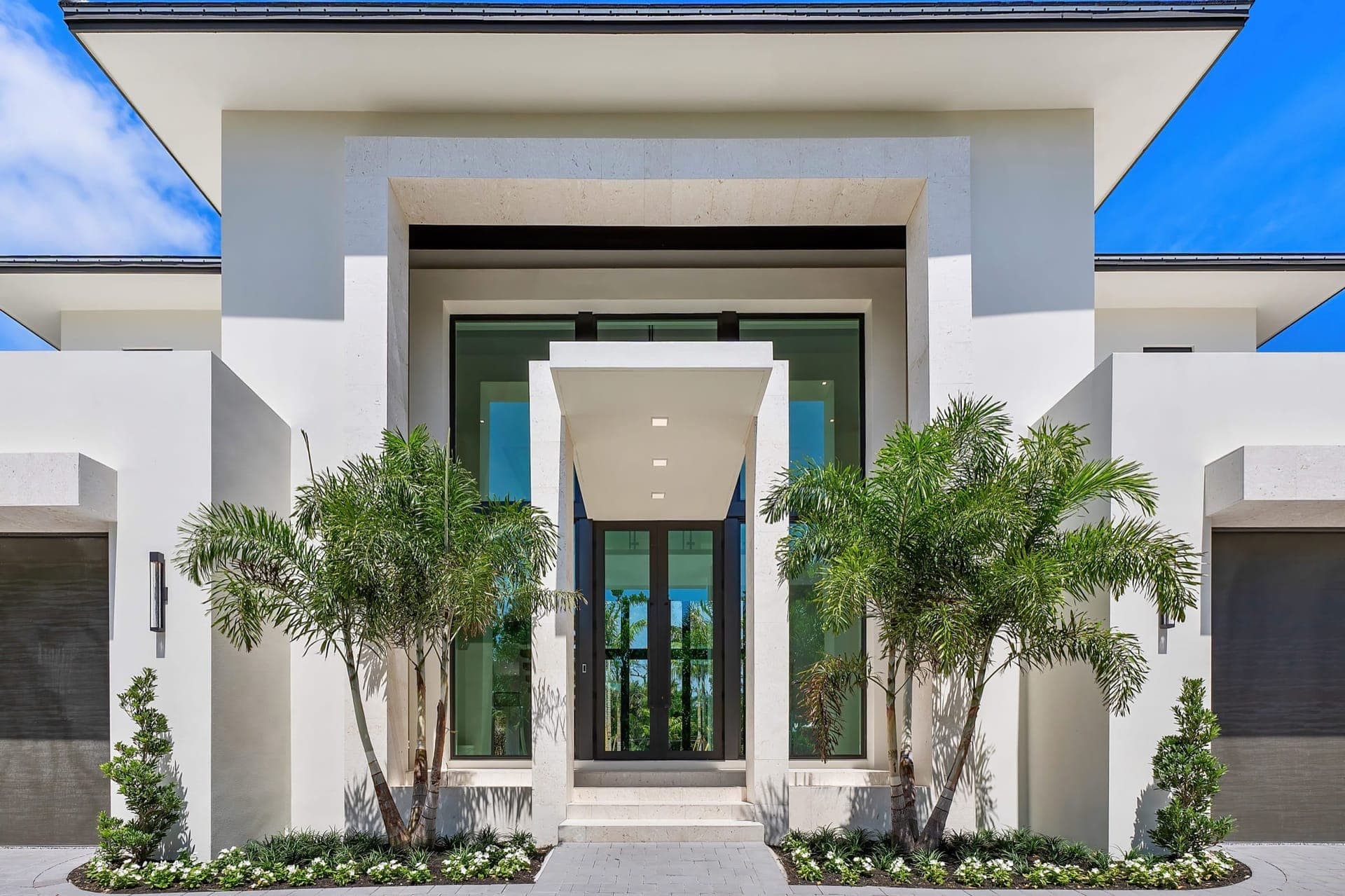
- Concrete block with quality stucco finish and acrylic paint systems
- Natural stone (limestone, coral stone, travertine)
- Fiber cement siding with factory primer and quality paint
- Aluminum and stainless steel hardware and fixtures
- Concrete and porcelain pavers
- Impact-rated aluminum window frames with protective finishes
Specifications that fail:
- Wood siding without ongoing sealing and maintenance
- Mild steel fasteners and fixtures in coastal environments
- Lower-quality paint and stain systems
- Galvanized metal in marine air (corrodes more quickly than stainless)
- Standard kitchen-grade cabinetry used outdoors
Construction sequencing
Specifying materials?
Tell us your project. We will steer you toward what survives this climate and away from what looks great for two years.
Talk Through Your SpecsSome humidity effects are created during construction rather than after. Key sequencing disciplines:
- Do not install interior hardwood flooring until drywall is complete, painting is done, and the HVAC has been operating for at least 2 weeks to bring interior humidity to occupancy levels
- Cabinet installation should happen after flooring and after interior humidity has stabilized
- Protect wood materials stored on site from rain and direct ground contact
- Run dehumidification during the drywall and finish phases if interior humidity is above 60 percent
Building custom homes in South Florida over time teaches you what works and what does not. Our material specifications across projects reflect accumulated experience with what performs in this climate and what does not. You can read more about our approach on our custom home building page.
Frequently Asked Questions
Can I install solid hardwood flooring in a South Florida custom home?
Yes, with attention to species selection and installation. Rift-cut or quartered white oak performs well. Installation should happen after interior humidity has stabilized, and the flooring should be acclimated on site for at least a week before installation. Engineered hardwood is more forgiving and is our default specification on most projects.
How much does mildew resistance actually matter in paint selection?
In humid interior spaces (bathrooms, kitchens, laundry, basements if applicable), significantly. Paint that lacks proper mildewcide will develop visible mildew on bathroom walls within a year or two, requiring repainting. Quality mildew-resistant paint in these spaces is a straightforward upgrade that pays off quickly.
Do I need a whole-house dehumidifier in a new custom home?
Sometimes. On tight, high-efficiency homes with proper air sealing, a supplemental dehumidifier helps maintain comfortable interior humidity (typically 50 to 55 percent) year-round. On homes built to older or less rigorous sealing standards, the cooling system usually dehumidifies adequately on its own. Your HVAC designer should evaluate the specific home.
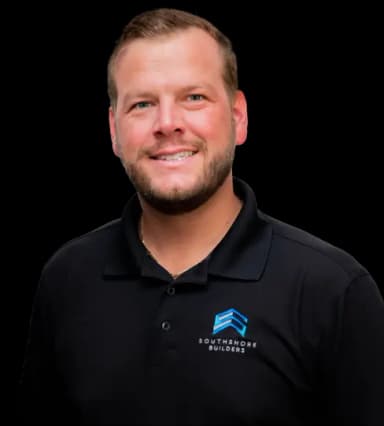
President, SouthShore Builders
Chase Lamson leads SouthShore Builders with decades of South Florida custom home experience. SouthShore is a licensed general contractor serving Palm Beach County and Broward County.