Modern and contemporary are not interchangeable: modern refers to a specific architectural movement that dominated roughly 1920 to 1970, defined by flat or low slope roofs, expansive glass and minimal ornament. Contemporary simply means the architecture of the current time, so its look keeps changing, and a home that was contemporary in 2005 no longer reads that way. Most South Florida homes called modern are actually modern influenced, borrowing those principles and pairing them with current elements like large sliding glass systems and warmer materials.
Modern and contemporary are the two most commonly confused terms in residential architecture. They are often used interchangeably in listing descriptions, builder marketing, and casual conversation about custom homes. The confusion is understandable because the terms overlap in everyday language. But they refer to different things, and the distinction matters for designers, builders, and clients trying to communicate clearly about what a home should be.
Modern architecture is a specific historical movement
Modern in architecture refers to a defined movement that emerged in the early twentieth century and dominated western architecture roughly from 1920 through 1970. Its key figures include Le Corbusier, Walter Gropius, Ludwig Mies van der Rohe, Frank Lloyd Wright, Richard Neutra, and Philip Johnson. Its principles were articulated through manifestos and built work: form follows function, ornament is unnecessary, buildings should reflect their structural logic, industrial materials should be celebrated rather than hidden, and space should flow rather than be divided into traditional rooms.
Modern architecture produced specific recognizable buildings: the Farnsworth House, Fallingwater, the Seagram Building, the Bauhaus buildings in Germany. In residential application, modern architecture produced mid-century modern homes with flat or low-slope rooflines, expansive glass, horizontal massing, minimal ornament, and an emphasis on the connection between interior and exterior. These homes were not trying to be "current"; they were trying to express the modern movement's principles.
Modern as an architectural term is historically specific. It refers to a movement, not to "whatever is being built now."
Contemporary architecture is whatever is being built now
Contemporary literally means "of the current time." Contemporary architecture is the architecture being produced today, regardless of stylistic lineage. It includes modern-derivative work, postmodern work, deconstructivist work, regional vernacular work, and everything else currently being designed.
Because contemporary means current, the style evolves constantly. A home that was contemporary in 2005 is no longer contemporary by that definition, because contemporary has moved forward. A modern home from 1950 is still modern, because modern refers to the movement it was built within.
Why this matters for custom home conversations
The confusion between modern and contemporary causes real miscommunication. When a client says "I want a modern home," they may mean:
- A home in the mid-century modern tradition (flat roofs, minimal ornament, expansive glass)
- A home that looks current (which could be many different styles)
- A home that feels clean and uncluttered rather than traditional
- Something they saw on Instagram that they liked
Each of those interpretations points to a different design direction. Architects and builders who are paying attention ask clarifying questions when clients use these terms. Architects and builders who are not can end up designing homes that technically match one interpretation but miss what the client actually wanted.
The hybrid reality in South Florida
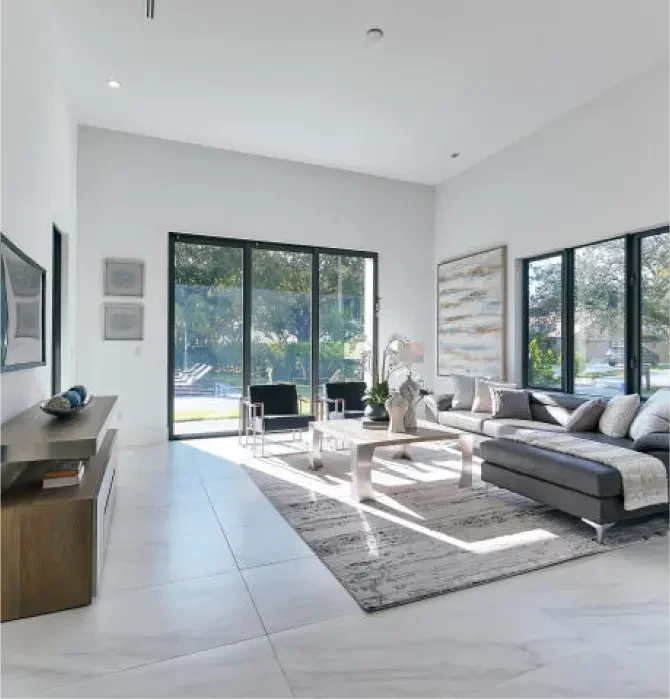
Most South Florida custom homes described as modern are actually modern-influenced rather than strictly modern in the historical sense. They borrow specific elements from modern architecture (flat or low-slope rooflines, expansive impact glass, minimal exterior ornament, open interior plans) while incorporating contemporary elements that would have been unfamiliar to mid-century modernists (integrated smart home technology, open indoor-outdoor living, large format sliding glass systems, natural stone accents, warmer material palettes than the mid-century canon).
This is why SouthShore categorizes our project styles more specifically: modern coastal, contemporary, transitional, modern farmhouse, modern transitional. Each term picks up a specific stylistic lineage. "Modern coastal" reads as modern-derivative with South Florida coastal adaptations. "Contemporary" reads as current without committing to a specific stylistic tradition. "Transitional" reads as between traditional and contemporary. The vocabulary allows more precise communication than the single word modern can support.
How to evaluate architectural style descriptions
When evaluating a custom home described by style, useful clarifying questions include:
- Can you show me 3 to 5 completed homes that match what you mean by that style?
- What are the defining exterior features?
- What interior details are characteristic?
- How does the home relate to its site and climate?
- What would feel wrong in a home of this style?
These questions translate a vague style label into specific design decisions. They also reveal whether the person using the style term has a clear definition or is using it loosely.
Contemporary is a moving target
Working out your direction?
Send us what you are drawn to and your lot. We will tell you what translates to this market.
Talk Through Your DesignOne practical consequence of contemporary's definition (of the current time) is that contemporary homes date. A home built to be contemporary in 2010 still stands, but it no longer reads as contemporary because the contemporary of 2026 has moved past 2010 conventions.
For clients commissioning custom homes, this suggests a tradeoff. Contemporary homes built to the current moment will read as dated in 15 to 20 years. Modern-derivative homes built to more durable architectural principles age differently, as period-specific rather than outdated. Neither is wrong; the tradeoff is between expressing the current moment fully and designing for longevity.
The architects and builders we work with most often help clients navigate this by identifying which elements to pull from current trends (typically interior finishes and fixtures, which are easier to update) versus which to design for long-term relevance (typically massing, material palette, and architectural proportions). A well-balanced custom home reads as current at completion and continues to read well for decades. You can see examples in our projects portfolio.
Frequently Asked Questions
Is modern coastal actually modern or contemporary?
Modern coastal is modern-derivative. It borrows elements from modern architecture (flat roofs, minimal ornament, expansive glass) and adapts them to South Florida coastal context (humidity-resistant materials, indoor-outdoor living, climate response). It is not historically modern in the mid-century sense, but it reads as modern in everyday usage.
What style label should I use if I want something current but lasting?
Transitional or modern coastal are the two safest labels in our market. Both produce homes that read as current and age well. The choice between them depends on whether you prefer warmer traditional elements (transitional) or cleaner modern lines (modern coastal). Both have produced custom homes that still look current 10 years after completion.
Is contemporary the same as minimalist?
No. Minimalism is one specific contemporary direction, but contemporary architecture encompasses many approaches, some of which are ornate, colorful, or expressive rather than minimalist. If you want minimalist specifically, use the word minimalist rather than contemporary to avoid confusion.

President, SouthShore Builders
Chase Lamson leads SouthShore Builders with decades of South Florida custom home experience. SouthShore is a licensed general contractor serving Palm Beach County and Broward County.