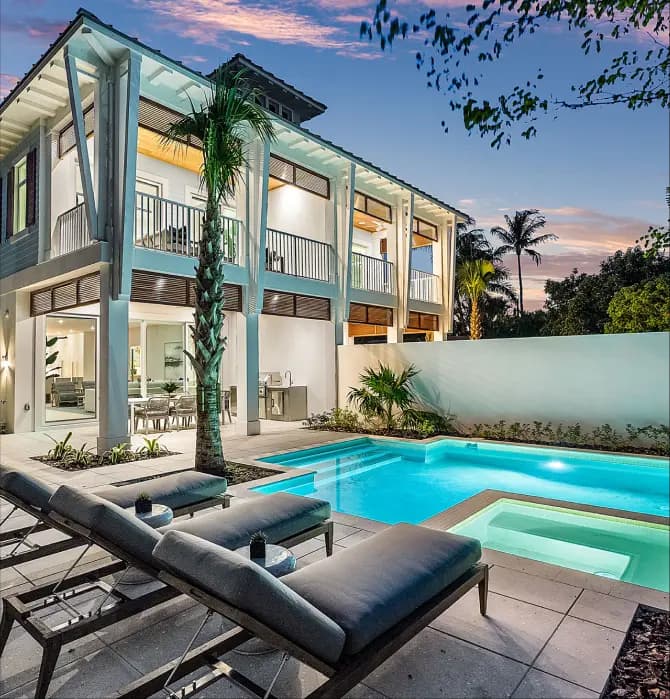
Design the pool at the same time as the home, with the architect, builder, and pool contractor coordinating from early design development. That is when placement, deck level versus raised edges, spa configuration, setbacks, and equipment location can be resolved alongside the architecture, and when the plumbing, electrical, and deck interfaces with the slab get worked out. A custom gunite pool and spa typically runs $100,000 to $250,000 or more in Palm Beach County.
The pool is one of the most-used features of a South Florida custom home, but it is also one of the most commonly added as an afterthought. Clients who design the home first, then call a pool contractor after the slab is poured, end up with pools that work functionally but do not integrate with the architecture or the outdoor living program. The pools on our best projects are designed at the same time as the home, by architects, builders, and pool contractors coordinating from early design development. The result reads as a single project rather than a home plus a separate pool.
Pool types for South Florida custom homes
The dominant pool construction in our market is gunite (pneumatically applied concrete over a reinforcing steel cage) with interior finish in plaster, quartz aggregate, pebble aggregate, or tile. Gunite allows custom shapes, depths, and integrated features (benches, sun shelves, spas, water features). Construction cost for a custom gunite pool and spa typically runs $100,000 to $250,000-plus in Palm Beach County, depending on:
- Pool size and depth
- Interior finish (plaster is least expensive, premium pebble aggregate is mid-range, all-tile interiors are the top)
- Edge detail (standard deck edge versus deck-level, infinity edge, or vanishing edge)
- Water features (deck jets, scuppers, spillways, sheer descents)
- Spa integration (attached spa versus separate)
- Equipment level (variable-speed pumps, heater type, automation)
- Coping material (travertine, marble, poured concrete, porcelain)
Pool integration with the architecture
The architectural integration decisions are where the difference between a good pool and a great one usually shows up. Key decisions include:
Placement relative to the home
Most South Florida custom homes place the pool at the rear of the lot, visible from the main living spaces through large sliding doors. The specific placement within that rear-yard zone matters: pools positioned directly in front of a covered lanai create a continuous outdoor living experience, while pools offset to one side create different zones (lounging and dining adjacent to the home, pool and sun shelf further out).
Deck level versus raised
Deck-level pools (where the water surface sits flush with the pool deck) produce a cleaner architectural line and a more modern appearance. They are slightly more expensive due to the gutter detailing required to manage water movement. Raised pools with conventional coping are less expensive, have simpler mechanical systems, and read as more traditional. On modern coastal homes, deck-level is almost always the right choice. On transitional homes, either works.
Infinity and vanishing edges
Infinity-edge pools (where one side of the pool is a waterfall edge over a hidden trough) are dramatic features when the edge is oriented toward a view: ocean, Intracoastal, or landscape feature. They are expensive (typically $40,000 to $80,000 added cost over a standard-edge pool of the same size) and require careful engineering to make the edge read as a clean horizontal line. They also require more sophisticated mechanical systems to handle the continuous water movement.
Spa integration
Spas on South Florida custom homes are almost always integrated with the pool rather than freestanding. Common configurations include a raised spa at one end of the pool (visually distinct), a flush spa integrated into the pool deck at the same level (unified appearance), or a spa elevated above the pool with a spillway that flows into the pool (dramatic, more expensive). Each has visual and functional tradeoffs.
Pool setbacks and coverage
Pool placement is constrained by municipal setback requirements that differ from main structure setbacks. In Delray Beach, pools typically require 10-foot setbacks from the rear property line and 7.5 feet from side property lines, with additional requirements for equipment and pumps. Lot coverage calculations in some jurisdictions include pool deck area, which can affect how much pool deck you can build on a tighter lot. These constraints should be verified during pre-construction, not discovered at permit review.
Equipment and automation
Pool mechanical equipment (pumps, filters, heaters, salt or chlorine systems, automation controllers) needs a dedicated location that is accessible for service, electrically compliant, and visually screened from primary views. A pool equipment pad tucked behind landscaping near the garage or side yard is typical. Automation controllers connected to a home automation system (Crestron, Savant, Control4, or the pool manufacturer's app-based system) are standard on higher-end projects. Variable-speed pumps reduce operating cost significantly compared to single-speed pumps and should be spec'd on any new pool.
The role of the pool contractor
Adding a pool?
Tell us the lot and what you want. We will tell you where it can go, what it costs, and how it sequences with the house.
Get a Pool EstimatePool contractors are licensed and regulated separately from general contractors in Florida. Most GCs coordinate with a specialist pool contractor rather than building pools in-house. The coordination requires attention: pool construction happens in parallel with site work and foundation, and the interfaces (plumbing rough-ins for water features, electrical feeds for equipment, deck integration with the home's slab) need to be worked out in advance. SouthShore works with several established pool contractors in our service area and coordinates the scope as part of our custom home building delivery.
Frequently Asked Questions
How early in the project do I need to decide on the pool?
Pool design should be in progress by the time the home is at 50 percent schematic design. Specific dimensions and mechanical requirements should be locked in before the home's foundation is poured, because plumbing and electrical stubs for the pool need to be coordinated with site work.
Is a salt pool better than a chlorine pool?
Salt pools are chlorine pools that generate chlorine from salt instead of requiring manual chlorine addition. The water is gentler on skin and eyes, maintenance is simpler, and operating costs over time are lower. Upfront equipment cost is higher. In most South Florida custom home applications, salt systems are the preferred choice.
How much does a pool add to resale value?
In South Florida markets, a well-designed pool is close to a requirement on higher-end custom homes. Homes without pools typically trade at a discount to comparable homes with pools. Whether the pool fully recovers its construction cost at resale depends on the design quality and the market, but on East Delray, Boca Raton, and coastal properties, the pool is rarely optional for the buyer pool.

President, SouthShore Builders
Chase Lamson leads SouthShore Builders with decades of South Florida custom home experience. SouthShore is a licensed general contractor serving Palm Beach County and Broward County.