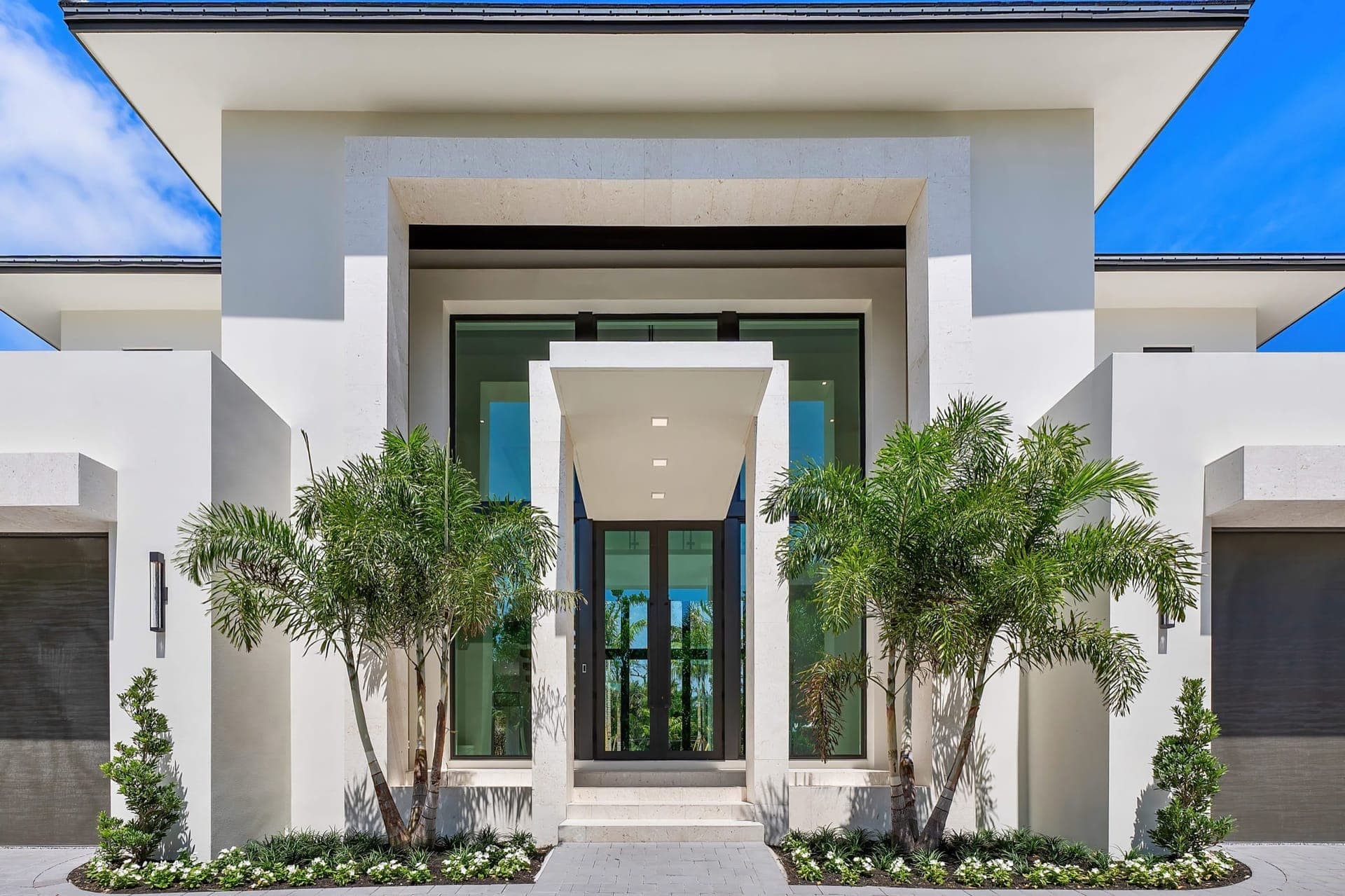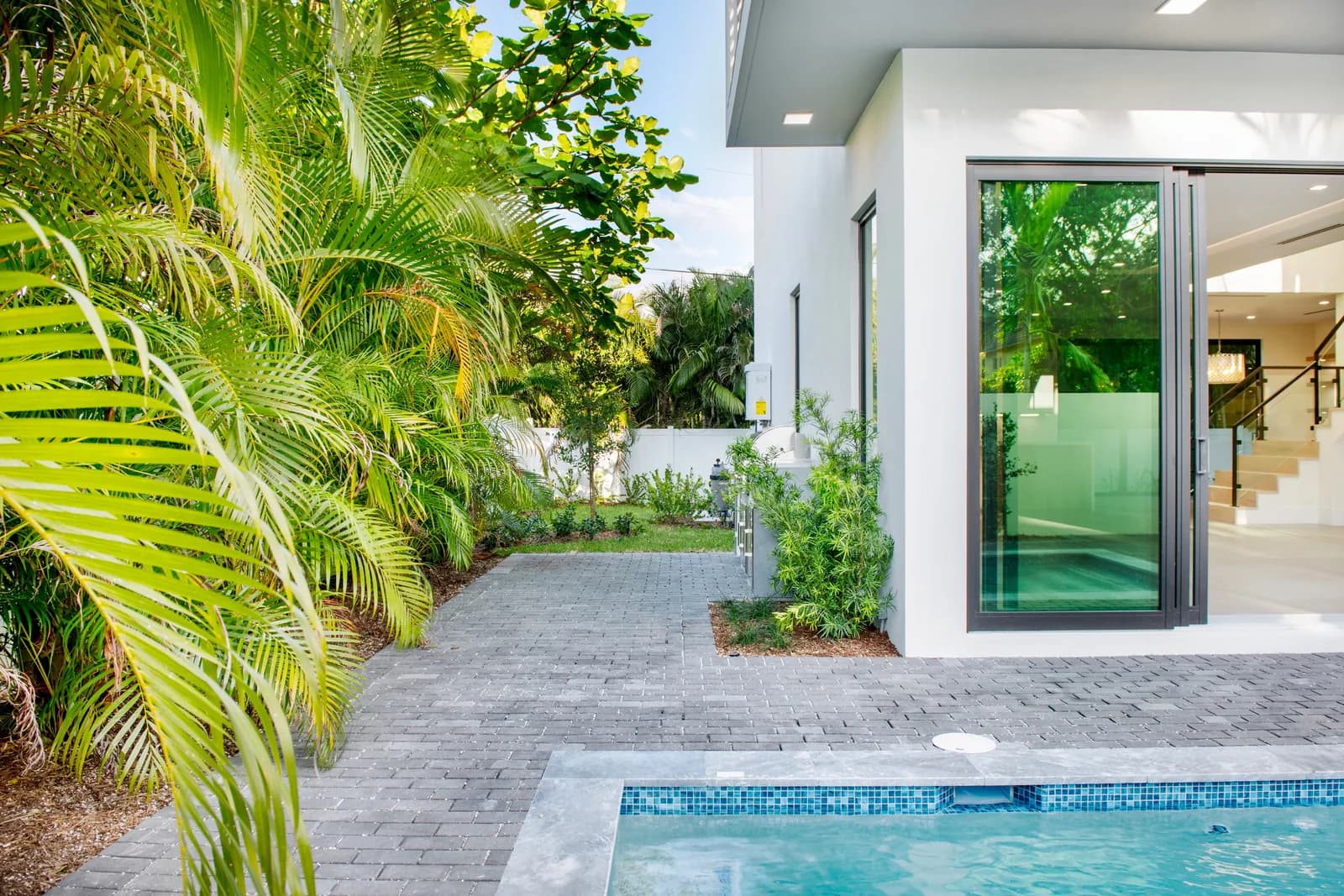
For most South Florida custom homes, concrete block and stucco (CBS) is the better choice for exterior walls, and it is our default. CBS offers more mass against wind borne missiles, wind insurance premiums often 10 to 25 percent lower, near immunity to termite damage on exterior walls, and a total cost usually within 5 percent of wood frame on a finished home. Wood frame still makes sense for second floors, interior walls, roof trusses, and styles like modern farmhouse.
The question of CBS (concrete block and stucco) versus wood-frame construction comes up on almost every custom home inquiry in South Florida. The answer is not ideological. Both systems are code-compliant, both can perform well, and both appear in luxury custom homes across Palm Beach and Broward Counties. But the tradeoffs between the two are specific, and the right system for a particular project depends on what the client prioritizes.
What CBS construction is
Concrete block and stucco construction uses concrete masonry units (CMUs, commonly called concrete blocks) stacked with mortar, reinforced vertically and horizontally with steel, and grouted solid in key locations. The exterior is finished with stucco applied directly to the block. Interior walls are often wood-framed or lightweight steel-framed even in CBS homes; the CBS designation typically refers to exterior walls.
CBS has been the dominant construction type for South Florida exterior walls for decades. Roughly 80 to 90 percent of new custom homes in Palm Beach and Broward Counties use CBS exterior construction.
What wood-frame construction is
Wood-frame construction uses dimensional lumber (typically 2x6 exterior walls in current Florida construction, sometimes 2x4 or engineered studs) with sheathing, weather-resistive barrier, and exterior cladding. The cladding can be stucco (over lath and sheathing), siding, stone, or a combination.
Wood frame is standard in most of the country but is less common on South Florida exterior construction. It is more common on second floors, interior framing, and roof systems even within predominantly CBS homes. Pure wood-frame exterior construction is a minority of our market.
Hurricane performance
Both systems can meet Florida Building Code high-velocity wind zone requirements when properly engineered. The practical difference is that CBS has significantly more mass and is inherently less prone to wind damage from wind-borne missiles. A concrete block wall takes substantial direct impact without failing, whereas wood-frame walls rely more heavily on the sheathing and cladding to maintain envelope integrity.
In real-world hurricane performance across decades of Florida construction, well-built CBS homes have consistently shown better post-storm outcomes than well-built wood-frame homes of equivalent age. This is not dispositive (both systems have survived major hurricanes when built to current code), but it is the background reality that drives CBS preference in this market.
Insurance implications
Florida insurance carriers favor CBS construction for wind coverage. Premium differentials between CBS and wood-frame homes of comparable size and age can be meaningful, often 10 to 25 percent on the wind component of the policy. Over 20 years of ownership, that differential compounds into significant money. The difference has narrowed somewhat as wood-frame construction with full impact envelope and proper wind detailing has become more common, but the CBS advantage persists.
Termite considerations
CBS is essentially immune to termite damage on exterior walls. Wood-frame construction requires diligent pest management (pressure-treated sill plates, preventive treatments, ongoing monitoring) in a subtropical climate that strongly favors termite activity. This is not insurmountable on wood-frame construction but is one more maintenance consideration that CBS eliminates.
Cost comparison
On hard construction cost for equivalent square footage, CBS typically runs slightly more than wood frame at the framing stage (5 to 10 percent, depending on labor market conditions). The total envelope cost difference is smaller once you factor in sheathing, weather barriers, and the other items that wood frame requires but CBS does not. On a completed home with interior and finish work, the total cost differential between CBS and wood-frame homes of comparable quality is usually within 5 percent.
Where wood frame makes sense
Despite the CBS dominance in our market, wood frame appears in several specific situations:
- Second floors on predominantly CBS first floors (wood-framed second floors are very common)
- Interior walls within CBS homes (almost universal)
- Roof systems and trusses (wood is dominant)
- Full wood-frame construction on specific architectural styles like modern farmhouse, where the design intent includes visible wood elements
- Modular or manufactured homes (though these are rare in our custom market)
- Budget-driven custom builds where cost savings on framing matter more than long-term insurance and maintenance advantages
ICF as a premium alternative
Insulated Concrete Forms (ICF) are a premium construction system that uses hollow foam blocks filled with concrete and reinforcing steel. ICF offers superior thermal performance, excellent hurricane resistance, and reduced sound transmission compared to standard CBS. The cost premium over CBS is significant (typically 10 to 20 percent more on structural walls), but ICF is specified on a growing number of high-end custom projects in our market, particularly in coastal zones where the performance benefits are most valuable.
What we default to
Deciding on structure?
Tell us your lot and your design. We will price both ways and explain what changes beyond the framing.
Talk Through the StructureSouthShore's default construction for exterior walls in our service area is CBS. The combination of hurricane performance, insurance advantage, termite resistance, and low-maintenance durability is difficult to argue against in this climate. We use wood framing for second-story exterior walls on some projects when the architectural and structural program supports it, and we use ICF on select coastal and architecturally demanding projects where the client values the premium performance. You can see a range of construction approaches across our completed projects.
Frequently Asked Questions
Is CBS significantly slower to build than wood frame?
Marginally. CBS exterior walls take 1 to 3 weeks longer on a typical custom home than wood frame, depending on height and complexity. On a 14 to 22 month total build timeline, the difference is not material. Good CBS masonry crews in our market keep the schedule tight.
Do CBS homes have any disadvantages I should know about?
CBS walls are difficult to modify after construction. Cutting openings for new windows, doors, or significant electrical runs involves core-drilling or saw-cutting reinforced concrete block. For homes that may see major renovations in the future, wood frame is more forgiving. This is usually a minor consideration compared to the performance benefits of CBS in our climate.
Can I finish a CBS home to look identical to a wood-frame home?
Visually, yes. With interior wall finishes in place, it is typically impossible to tell a CBS home from a wood-frame one by appearance. The difference is in wall thickness (CBS walls are slightly thicker) and in how the home feels acoustically (CBS homes transmit less outside noise), but the architectural expression is fully independent of the underlying construction type.

President, SouthShore Builders
Chase Lamson leads SouthShore Builders with decades of South Florida custom home experience. SouthShore is a licensed general contractor serving Palm Beach County and Broward County.