Your lot's FEMA flood zone sets the finished floor elevation, the foundation type, and the flood insurance premium for the life of the home. Zone X has no federal elevation requirement and allows conventional construction, Zone AE requires the finished floor at or above Base Flood Elevation plus local freeboard (typically 1 to 2 feet in Palm Beach County), and Zone VE requires elevated foundations on pilings or engineered piers and typically costs 15 to 30 percent more to build than Zone X. Confirm the zone before you buy through an Elevation Certificate, the FEMA Map Service Center, or the municipal GIS portal.
Flood zone designation is one of the most consequential pieces of information about a South Florida residential lot, and one of the least understood by buyers. It affects the finished floor elevation the home must be built to, the foundation type the structural engineer will specify, the annual flood insurance premium the owner will pay for the life of the home, and in some cases whether the home can be insured at all. Before you buy a lot in Palm Beach County or Broward County, you need to know what flood zone it is in and what that zone implies.
FEMA flood zone designations explained
FEMA publishes Flood Insurance Rate Maps (FIRMs) that assign every property in the United States to a flood zone. The designations that matter most in South Florida residential construction are:
- Zone X: areas of minimal flood risk, not required to elevate, not required to carry flood insurance by federal mandate
- Zone AE: areas with a 1 percent annual chance of flooding (100-year flood), with a defined Base Flood Elevation (BFE) that structures must be built to or above
- Zone AH and AO: shallow flooding zones, less common in coastal South Florida
- Zone VE: coastal high hazard areas with wave action during storm events, requiring elevated foundations on pilings or engineered piers
- Zone D: areas where flood hazard analysis has not been completed, less common in developed South Florida
The Base Flood Elevation is the critical number for construction in Zone AE and VE. It is the elevation above which a structure must be built to be considered code-compliant. Local jurisdictions typically add a "freeboard" requirement on top of BFE, usually 1 to 2 feet in Palm Beach County. A Zone AE lot with a BFE of 7 feet NAVD88 and a 1-foot freeboard requirement would require a finished floor at 8 feet NAVD88 or higher.
How flood zones affect construction in practice
In Zone X, construction is conventional. Finished floor is set by the architect and engineer based on site drainage, driveway grade, and programmatic considerations, not by flood code. Spread footing foundations are standard. Flood insurance is optional (though often required by lenders).
In Zone AE, the finished floor must meet or exceed BFE plus freeboard. This affects the foundation design (either a taller slab with fill, a stem wall foundation, or a raised crawl space), the driveway and site grading, and often the first-floor ceiling height because the overall building height limit is measured from grade. On flat lots in Delray Beach, achieving a Zone AE finished floor often means bringing in fill to raise the site, which has its own cost and drainage implications.
In Zone VE, the requirements escalate significantly. Foundations must be elevated on pilings or engineered piers, with the lowest horizontal structural member above BFE. Enclosed space below BFE is heavily restricted. Walls below BFE must be breakaway, meaning they fail under wave action without compromising the structural foundation. Construction costs in Zone VE typically run 15 to 30 percent higher than equivalent construction in Zone X.
Where flood zones fall across our service area
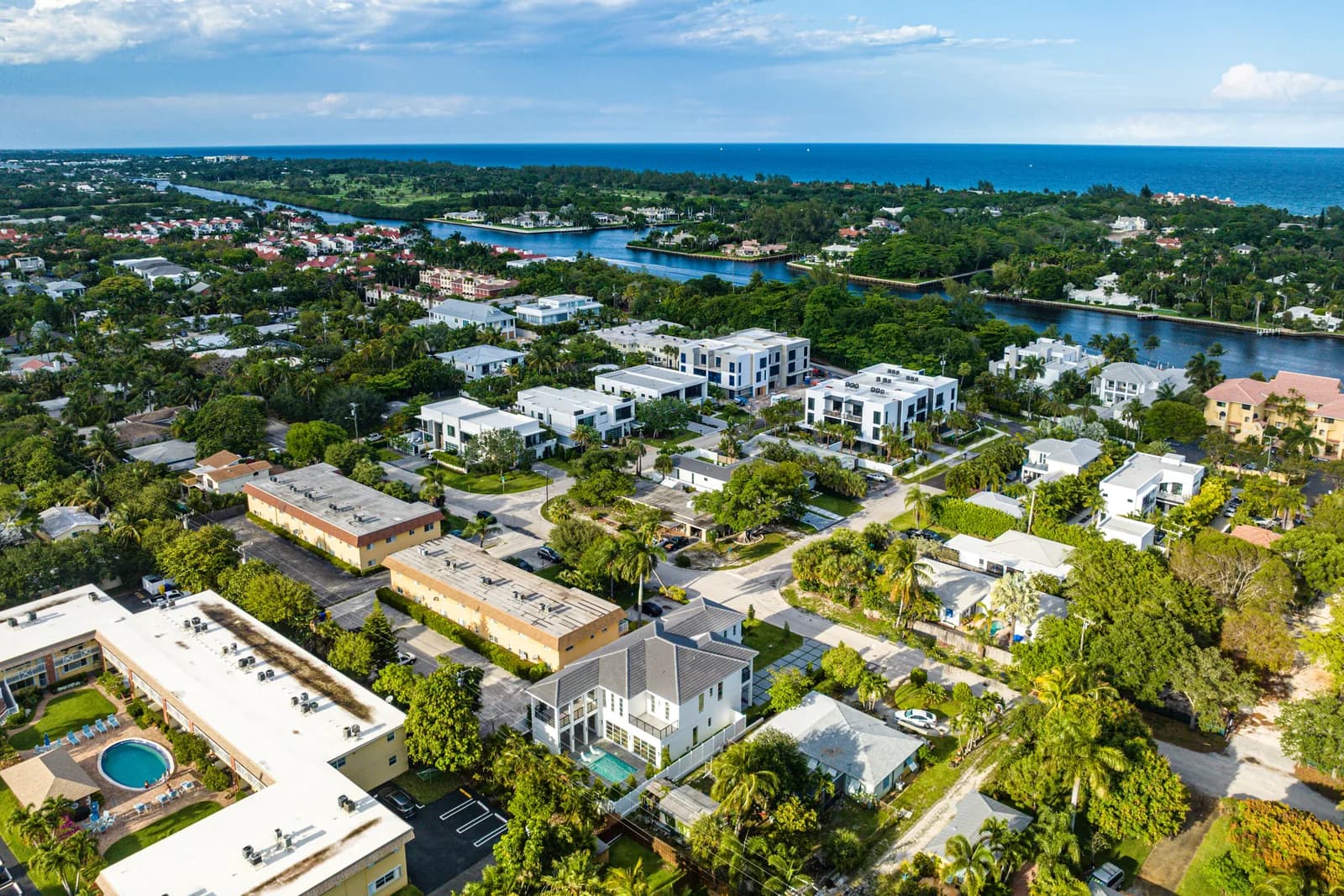
Most of central and western Delray Beach falls into Zone X. East Delray Beach, especially areas near the Intracoastal Waterway, has a mix of Zone X and Zone AE. Beachside properties in Delray and Ocean Ridge are typically Zone AE. Properties on the Atlantic Ocean side of A1A in Ocean Ridge, Gulf Stream, and Highland Beach are often in Zone VE. Palm Beach island has a mix of zones depending on distance from the ocean and the lake. Fort Lauderdale has extensive Zone AE along its canal network and Zone VE on oceanfront properties.
The best way to confirm the flood zone for a specific lot is to pull an Elevation Certificate if one exists, or to check the FEMA Map Service Center and the municipality's GIS portal. Zone designations can also be confirmed through a surveyor who produces a current boundary and topographic survey.
Flood insurance and cost
Flood insurance is available through the National Flood Insurance Program (NFIP) and increasingly through private carriers. NFIP premiums in Zone X are typically a few hundred dollars annually. NFIP premiums in Zone AE scale based on the finished floor elevation relative to BFE: a home built at BFE costs more than a home built at BFE plus 2 feet, which costs more than a home built at BFE plus 4 feet. Premiums in Zone VE are significantly higher, often running several thousand dollars per year for a primary residence and materially more for higher-value homes.
Under the current NFIP Risk Rating 2.0 framework, premiums are calculated based on a broader set of factors than historic flood zone alone, including individual property characteristics and replacement cost. Private flood insurance has become more competitive in recent years and frequently beats NFIP pricing on higher-value homes in coastal zones.
How SouthShore designs for flood compliance
Not sure what zone you are in?
Send us the address. We will tell you the flood zone, the required finished floor, and what it does to your budget.
Check My Flood ZoneFor every project in our service area, flood zone analysis is part of pre-construction. Before design development begins, we verify the current zone, pull the BFE if applicable, check the local freeboard requirement, and confirm any substantial improvement considerations for renovation projects. The finished floor elevation is set early, the foundation design follows, and the overall building envelope is designed around those constraints rather than discovered after the fact. On coastal projects in Zone VE, the structural engineer is engaged during pre-construction to produce preliminary piling design drawings in parallel with architectural development. You can read more about our pre-construction approach on our site due diligence page.
Frequently Asked Questions
Can I appeal a flood zone designation?
Yes. If you believe a specific property is mapped incorrectly (for example, the lot is at an elevation above BFE but mapped as Zone AE), you can file a Letter of Map Amendment (LOMA) with FEMA. The process involves an elevation certificate and supporting documentation. Successful LOMAs remove the property from the high-risk zone and can significantly reduce flood insurance costs.
Does flood zone affect property value?
Directly, yes. Two otherwise comparable lots where one is in Zone X and the other is in Zone AE or VE will typically trade at different prices, with the higher-risk zone discounted. The discount reflects both the construction cost differential and the ongoing insurance premium difference. In some markets, the discount is modest; in others, it is substantial.
What is the 50 percent rule and how does it interact with flood zones?
The FEMA substantial improvement rule requires that any renovation or improvement project exceeding 50 percent of the structure's market value bring the entire building up to current flood code, including elevation requirements. On a home in Zone AE that is below BFE, hitting the 50 percent threshold can trigger a requirement to elevate the entire home, which is often impractical. This is one reason teardown and new construction sometimes makes more economic sense than major renovation in coastal zones.

President, SouthShore Builders
Chase Lamson leads SouthShore Builders with decades of South Florida custom home experience. SouthShore is a licensed general contractor serving Palm Beach County and Broward County.